Puppies Aren’t Blank Slates: What Shapes Behaviour Before They Come Home?
 Emma Badger
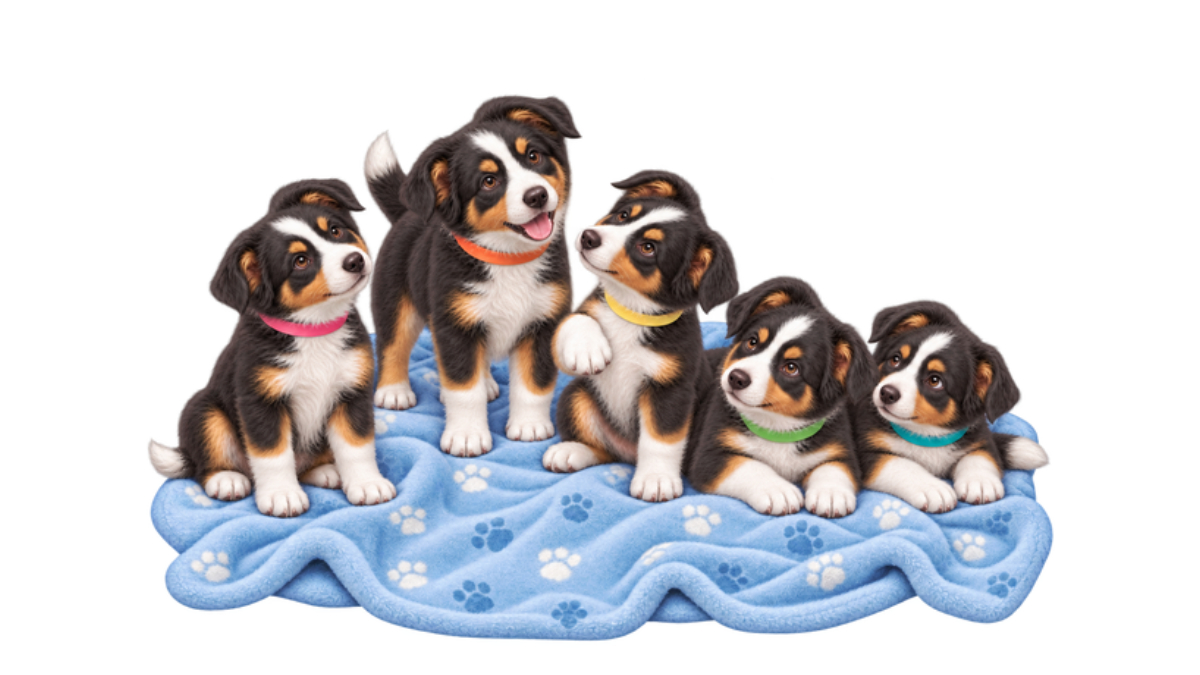
Puppies aren't blank slates. Learn how genetics, breed, prenatal influences, early experiences, and temperament can help shape behaviour.
“It’s all in how you raise them.”
You’ve probably heard that said about dogs.
There’s certainly some truth in it. What happens after your puppy comes home matters enormously. Their experiences, environment, health, learning history, relationships, and training will all continue to shape them as they grow.
But your puppy doesn’t arrive at eight weeks old as a completely blank canvas, waiting for you to create their personality.
They already have a history.
Genetics have played a part. Their parents have played a part. Their experiences before birth may have played a part. Their breeder, their littermates, and those first few weeks of life have all provided opportunities to learn about the world.
That doesn’t mean your puppy’s future has already been decided.
It means they arrive with a starting point of their own.
And understanding that starting point can make it much easier to support the puppy in front of you.
GENETICS AFFECT MORE THAN APPEARANCE
When we think about genetics, we often think first about things we can see.
Coat colour. Size. Ear shape. How much fluff is involved.
But genes can also influence behavioural tendencies.
They may contribute to differences in things such as:
- sensitivity to stress
- confidence
- sociability
- resilience
- responses to novelty
- predatory or chasing tendencies
- how easily a dog becomes excited or concerned by particular things
That doesn’t mean there is a single “confidence gene” or that genetics dictate exactly how a puppy will behave.
Behaviour is far more complicated than that.
A useful way to think about genetics is as part of the puppy’s starting framework. What happens afterwards continues interacting with that framework throughout life.
So genetics matter, but they aren’t destiny.
BREED MATTERS TOO, BUT IT ISN’T A PERSONALITY TEST
Dogs have been selectively bred for different jobs over many generations.
A Border Collie was developed for a very different purpose from a Labrador, a terrier, or a livestock guardian.
That history can influence the sorts of things dogs are naturally inclined to notice and do.
A herding breed may be particularly aware of movement. A gundog may find scent, carrying, or retrieving especially rewarding. A terrier may bring persistence and determination to a problem. Some guarding breeds may be naturally more cautious about unfamiliar people or situations.
Those tendencies aren’t good or bad.
They’re part of what makes different dogs different.
But breed should never become a shortcut for assuming we already know the individual dog.
Two dogs of the same breed can be remarkably different.
Breed gives us useful clues. The puppy in front of us gives us much better information.
YOUR PUPPY’S STORY STARTED BEFORE BIRTH
This is one of the fascinating parts of behaviour science.
A puppy’s development doesn’t suddenly begin on the day they’re born.
Prenatal simply means before birth, while perinatal refers to the period around birth.
Research across mammals shows that what happens during pregnancy can influence developing offspring. Maternal stress physiology, health, nutrition, immune activity, and other biological processes can all interact with development.
The dog-specific evidence is still more limited than we would ideally like, so it’s important not to turn this into a simple rule such as:
“Stressed mum equals anxious puppies.”
Biology doesn’t work that neatly.
What we can say is that the conditions in which puppies develop before birth may contribute to their starting point.
It’s another reason behaviour can’t be reduced to what happens after a puppy enters their new home.
MUM MATTERS AFTER BIRTH TOO
The mother continues influencing her puppies after they arrive.
Her behaviour, her own temperament, the way she interacts with her puppies, and the opportunities those interactions create can all become part of their early learning environment.
And even here, more isn’t automatically better.
Research into maternal care in dogs doesn’t give us a simple recipe where a particular amount of attention produces a particular type of puppy.
Different styles of maternal care may create different opportunities for puppies to practise skills.
That’s much more useful than trying to divide mothering into “good” and “bad”.
We’re looking at influence, not destiny.
THE PARENTS CAN GIVE US USEFUL CLUES
This is one reason I encourage prospective puppy owners to think about temperament as well as physical health when choosing a breeder.
If you can meet the puppy’s mother, watch her rather than simply asking whether she is “friendly”.
How does she seem to feel in the situation?
Can she relax when nothing is happening?
How does she respond to unfamiliar people or events?
If something surprises her, does she recover?
What does the breeder tell you about how she behaves in ordinary life?
The father may be less readily available, but information about his temperament can be useful too.
We aren’t looking for perfect dogs.
There’s no such thing.
We’re simply gathering information about some of the traits and tendencies that might contribute to the puppies’ starting points.
THE FIRST FEW WEEKS ARE ALREADY FULL OF LEARNING
Once puppies are born, development moves incredibly quickly.
At first, their abilities are extremely limited. As their senses, mobility, coordination, and awareness develop, their world begins to expand.
And that world provides learning opportunities long before a puppy arrives in their new home.
A thoughtfully raised litter might gradually experience:
- different safe surfaces
- gentle handling
- normal household sounds
- appropriate novelty
- safe opportunities to explore
- positive interactions with people
- age-appropriate enrichment
- opportunities to move away and rest
- changes in their environment without being overwhelmed
The important word there is appropriate.
Giving puppies the best possible start doesn’t mean bombarding them with as many experiences as possible.
More exposure isn’t automatically better.
Good early development should take account of the puppy, their age, their responses, and their ability to cope.
We want opportunities to learn, not a relentless programme of stimulation.
EVEN LITTERMATES CAN START FROM DIFFERENT PLACES
This is perhaps one of the clearest demonstrations that puppies aren’t blank slates.
Two puppies can:
- share the same parents
- grow during the same pregnancy
- be born into the same litter
- live in the same environment
- receive broadly similar care
and still be noticeably different.
One puppy may march straight towards something new.
Another might stop and watch first.
One might bounce back almost immediately after a surprise.
Another may need a little longer before deciding everything is safe again.
One may desperately want to be involved in whatever is happening.
Another might be perfectly happy watching from the sidelines.
Neither puppy is wrong.
They’re individuals.
And those differences matter when we decide what each puppy needs from us.
A CAUTIOUS PUPPY ISN’T A FAILED PUPPY
This is an especially important point once a puppy comes home.
Imagine two owners take their puppies to the same place.
One puppy happily explores almost immediately.
The other hangs back, watches, and needs much more time.
It can be very easy for the second owner to worry.
Have I socialised them badly?
Should I encourage them to get closer?
Why isn’t my puppy as confident as that one?
But confidence isn’t simply something we install by exposing a puppy to enough things.
The puppies may have arrived with different sensitivities, previous experiences, coping strategies, and individual temperaments.
That more cautious puppy may need a smaller world, more distance, more time to observe, and more opportunities to make safe choices.
Trying to make them behave like the confident puppy beside them can add pressure at exactly the point they need less of it.
SOCIALISATION DOESN’T MEAN TURNING EVERY PUPPY INTO THE SAME DOG
This is where the blank-slate idea can cause real problems.
If we believe every puppy starts in exactly the same place, it follows that every puppy should be able to cope with the same experiences at the same speed.
They can’t.
Good socialisation needs to be individualised.
For one puppy, watching something from twenty metres away may be easy.
For another, that might already be quite a lot to process.
One puppy may enjoy a brief interaction.
Another may learn far more by simply observing and then moving away.
The aim isn’t to produce a puppy who loves absolutely everybody and everything.
It’s to help your puppy develop the skills they need to navigate their world.
We’ll come back to socialisation properly in a future blog post, because there’s a lot more to it than “meet as many people and dogs as possible”.
WHAT DOES THE BREEDER HAVE TO DO WITH ALL THIS?
Quite a lot.
A breeder isn’t simply caring for puppies until they’re old enough to leave.
For those first weeks, they’re responsible for almost the whole of the puppy’s environment.
That doesn’t mean a breeder can manufacture a guaranteed temperament. They can’t.
But thoughtful breeding and rearing can help stack the odds in a puppy’s favour.
If you’re choosing a breeder, useful questions include:
- What are the parents like in everyday life?
- What health testing has been carried out?
- How are the puppies raised?
- What sorts of experiences do they have before leaving?
- How do you introduce novelty?
- What enrichment do the puppies have?
- How much opportunity do they have to explore and rest?
- How do you decide which puppy might suit which home?
A good breeder should be comfortable talking about much more than colour, markings, and which puppy is currently available.
WHAT IF YOUR PUPPY DIDN’T HAVE THE IDEAL START?
Then you start with the puppy you have.
There is no perfect beginning.
Puppies from excellent breeders can still develop difficulties.
Puppies who have had much less favourable early experiences can go on to become wonderful, happy companions.
A starting point is exactly that.
A starting point.
It isn’t a forecast of everything that will happen next.
The experiences your puppy has with you still matter.
So do:
- their physical health
- sleep and rest
- learning
- their environment
- the relationships they develop
- opportunities to practise useful skills
- how safe they feel
- the support they receive when things are difficult
Understanding where your puppy might be starting from simply helps us make better decisions about what comes next.
IF YOUR PUPPY IS ALREADY HOME, THIS ISN’T ABOUT LOOKING BACK FOR SOMEONE TO BLAME
Sometimes learning about genetics and early development can leave owners wondering whether something went wrong before they collected their puppy.
That usually isn’t a particularly useful place to stay.
We rarely have complete information about every influence on a dog’s development.
And behaviour is almost never the result of one single thing.
Instead, use what you notice about your puppy now as information.
What do they find easy?
What takes more effort?
How quickly do they recover?
What makes them light up?
What makes them hesitate?
Where do they need a little more help?
That tells us far more about how to support them than trying to work out exactly which part of their history created which behaviour.
YOUR PUPPY’S STARTING POINT IS INFORMATION, NOT A VERDICT
Perhaps the most useful thing we can take from all of this is permission to stop comparing puppies quite so much.
Your puppy doesn’t need to behave like their littermate.
They don’t need to respond like the puppy you saw on social media.
They don’t even need to develop exactly as another dog of the same breed did.
They arrive with their own combination of genetics, early development, experiences, temperament, strengths, and sensitivities.
Then life continues shaping them.
Our job isn’t to turn them into the puppy we think they ought to be.
It’s to understand the puppy who actually came home with us and help them develop from there.
Your puppy isn’t a blank slate. But their future isn’t already written either.
Categories: : Understanding Your Puppy